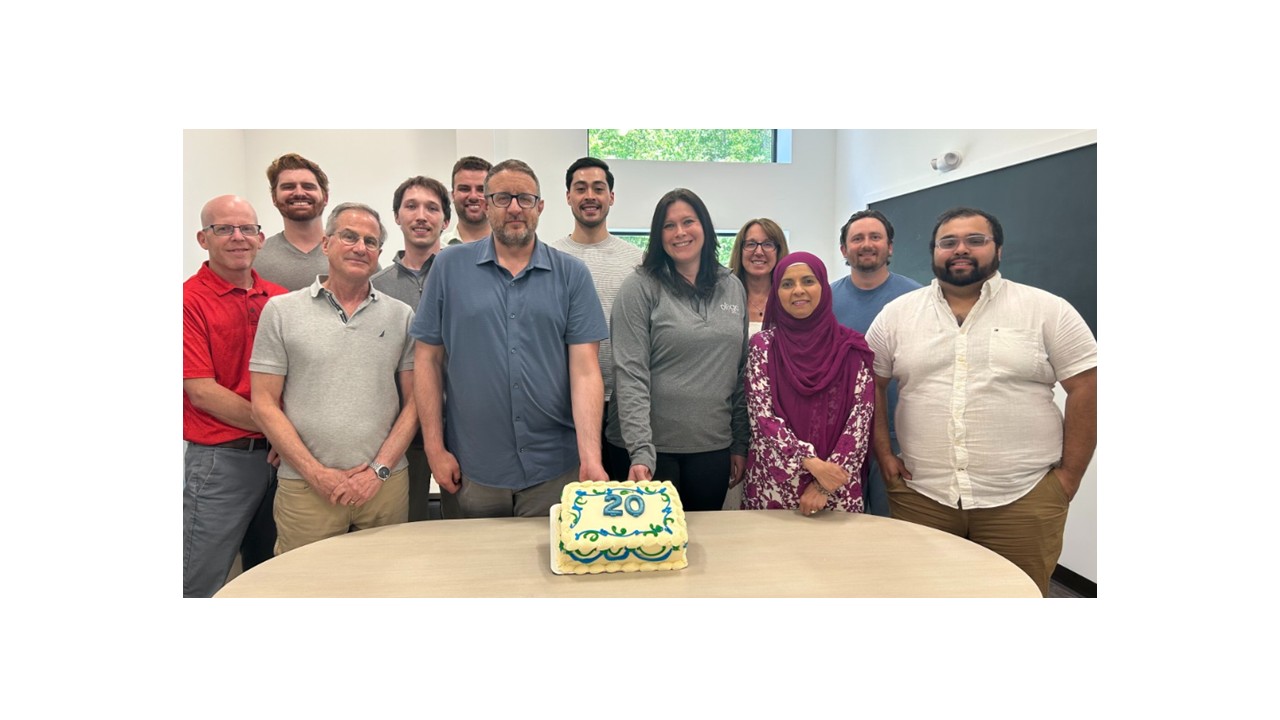
From Garage Synthesizers to GMP Therapeutics: The Story of Oligo Factory at 20
When people say Oligo Factory started in a garage, they’re only slightly exaggerating.
“The first Q Master synthesizer really was built in Rick’s garage,” says Amy Howie, Director of Manufacturing Operations and one of the company’s longest-serving employees.
Twenty years after its founding in 2006, Oligo Factory has grown from a tiny operation built around one homemade synthesizer into a 13,000-square-foot manufacturing facility supporting therapeutics, diagnostics, and life science developers and researchers around the world.
But the company’s core spirit hasn’t changed all that much. It’s always been about figuring things out, building better systems, solving problems, and being willing to get creative.
A Better Mousetrap
The company was founded by Rick Neves, a chemist and self-described tinkerer who had previously worked at Millipore and Waters, where he saw firsthand the limitations of commercially available oligonucleotide synthesizers.
“Rick had this ‘I can build a better mousetrap’ mentality,” Amy explains.
So he did.
Not only did Rick design the company’s first synthesizer himself, but he also taught himself how to code to write the software that operated it. Mike Richmond, an electrical engineer, soon joined him, creating what Amy describes as the perfect partnership: chemistry expertise paired with engineering know-how.
“They were kind of this ideal combination. Rick understood the chemistry and the synthesis side, and Mike could engineer the systems to make them work safely and reliably.”
In the early years, resources were limited, but ingenuity wasn’t.
The company bought used equipment from eBay, repurposed parts, and assembled systems piece by piece. Within Amy’s first six months at the company, she was handed a room full of spare parts and asked to build a functioning analytical system from scratch.
That resourcefulness became part of the company culture.
“When new chemistry challenges came up, we adapted quickly,” she says. “I remember one oligo we worked on years ago was oxygen-sensitive. Mike literally ran an argon line from a tank on the loading dock through the ceiling into the purification lab in under an hour. Problem solved.”
Scaling Up — Fast
When Amy joined in 2011, Oligo Factory specialized in what was then considered a relatively underserved niche: mid-scale oligonucleotide manufacturing.
At the time, most companies either focused on tiny research quantities or very large-scale production. Oligo Factory carved out space in between.
“We were doing maybe hundreds of milligrams of material,” Amy recalls. “Then we got our first order for multiple grams, and at the time it felt enormous.”
So enormous, in fact, that the team had to modify its software to add scroll bars to display the larger production values.
Today, the company routinely manufactures at scales that would have seemed unimaginable back then.
The original purification column Amy once considered gigantic had an internal diameter of 25 millimeters. Now, the lab runs columns measuring 100 millimeters across. Turnaround times for larger-scale production have dropped from four months to six weeks or less.
And the homemade Q Master synthesizer that started it all? It’s now in its third generation.
The company now has six Q Master 3.0 machines, or ‘NANDAs,’ named in honor of scientist and collaborator Nanda Sinha, the inventor of one of the most important improvements in oligo synthesis (the beta-cyano-ethyl form of the phosphoramidites). He worked closely with the team as a consultant until his passing in 2016.
“He would come in and kind of run amuck in the lab with me,” Amy says. “He was my go-to when I got a weird result and I couldn’t figure out what it was. He was great like that. And a bit of a celebrity at conferences.”
Built by Scientists, for Scientists
One of the defining characteristics of Oligo Factory has always been its intensely technical, hands-on culture.
For years, the company operated with only a handful of employees; essentially Amy, Rick, Mike, and a rotating cast of a few additional team members.
“There were times it was basically just the three of us holding everything together,” Amy says.
Even the company’s software systems were developed internally. What began as an Excel spreadsheet evolved into a custom-built laboratory information management (LIMS) system coded by Rick himself during nights and weekends. Mike engineered a real-time monitoring and alarm system that tracks chemical usage, waste flow, and leak detection across the synthesis lab.
That same spirit helped Oligo Factory evolve from a word-of-mouth business into a growing organization serving increasingly sophisticated markets.
For its first 15-plus years, the company had no sales team at all.
“We were entirely word of mouth until 2022,” Amy says.
Entering a New Era
The COVID-19 pandemic marked a turning point for both the biotech industry and Oligo Factory itself.
As demand for oligonucleotides surged globally, the company was acquired by private equity investors in 2021, enabling a new phase of growth and expansion. Rick and Mike have since retired from day-to-day operations, though both remain active consultants and trusted advisors to the team.
In 2023, Oligo Factory moved into its current 13,000-square-feet facility in Holliston, Massachusetts — a dramatic leap from the company’s original 2,000-square-foot space.
“Our first building fit everything — labs, offices, conference room — into 2,000 square feet,” Amy says. “Now just the purification lab alone is 1,600.”
The move also accelerated the company’s evolution into regulated manufacturing supported by a robust quality system, including ISO 9001, ISO 13485, and ICH Q7-compliant systems supporting therapeutic and diagnostic applications.
Today, Oligo Factory employs nearly 20 people and continues to expand its capabilities to best serve the therapeutics, diagnostics, and life sciences segments.
As Oligo Factory enters its third decade, the company is entering yet another new chapter, one shaped by a focus on supporting rare disease therapeutics, diagnostic assay, and platform and kit developers.
But according to CEO Luke Dannenberg, the company’s growth has only been possible because of the technical foundation built in its earliest years.
“The creativity and resilience started by our founders created a culture that still exists today,” he says. “That willingness and spirit to roll up your sleeves and innovate — whether it’s building custom instrumentation, adapting quickly to customer needs, or solving technical challenges in real time — continues to differentiate us.”